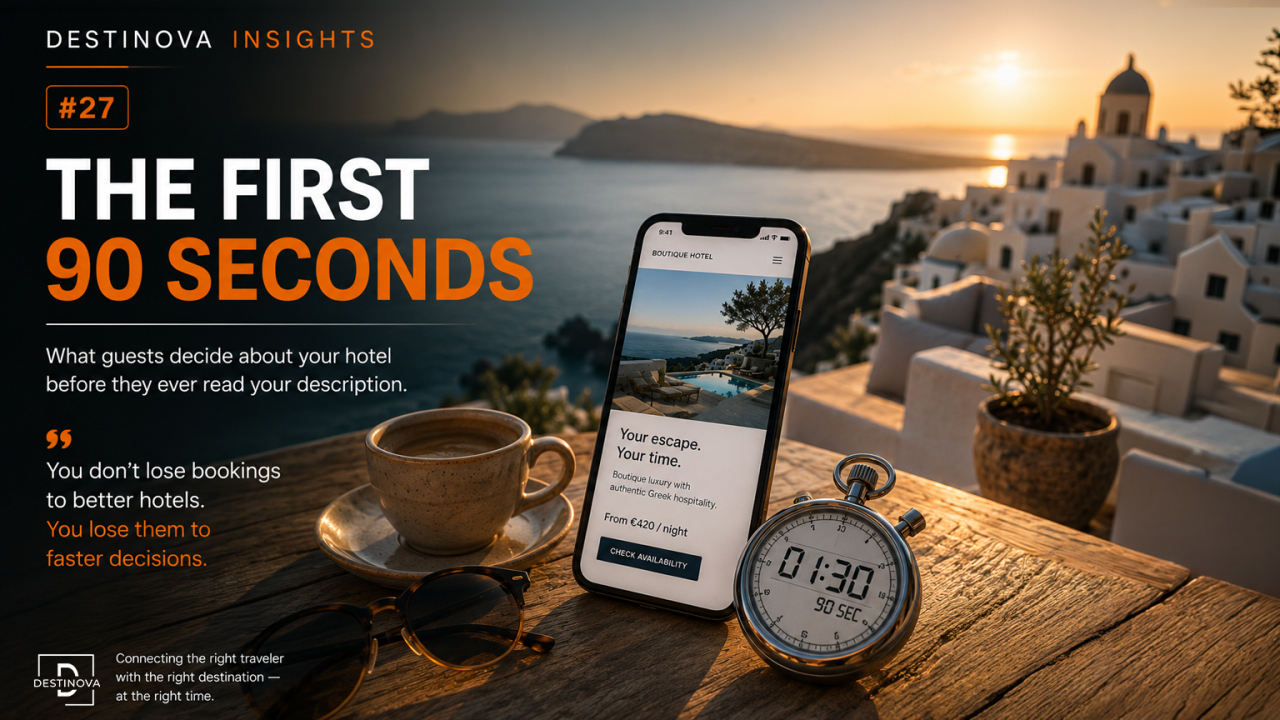
Most hoteliers think the booking decision happens at checkout. It doesn’t.
It happens in the first 90 seconds a traveler spends with you — long before they read your room descriptions, your reviews, or your cancellation policy. By second 90, the decision is usually already made. The rest is just confirmation.
Travelers don’t read their way to a booking. They feel their way to it — and the feeling is set in under two minutes.
What Actually Happens in Those 90 Seconds
A traveler clicks on your listing or website. In rapid succession, their brain processes:
- Seconds 1–5: Does this look like my kind of place?
- Seconds 5–20: Do the images match the promise of the title?
- Seconds 20–45: Is the price aligned with what I’m seeing?
- Seconds 45–90: Is there one specific reason this hotel is right for this trip?
If any of these answers is unclear, the tab closes. Not because the hotel is bad. Because the first impression didn’t earn the next 90 seconds.
The Audit Most Hotels Have Never Done
Here’s something you can do today, in under 10 minutes: open your hotel’s main booking page on your phone — not your desktop, your phone — as if you’d never seen it before. Start a timer. Then answer four questions.
1. In the first 5 seconds — does the hero image tell the traveler what kind of trip this is?
Not “what the hotel looks like.” What the trip feels like. A couples retreat looks different from a family getaway. A wellness escape looks different from a party destination. If your hero image could belong to any of them, it belongs to none of them.
2. In the first 20 seconds — does the headline answer “why here, not elsewhere”?
“Boutique hotel in Mykonos” is a description. It’s not a reason. “The last quiet bay in Mykonos” is a reason. So is “Where families return for the third generation.” So is “Sunset-facing suites, walking distance to old town.” A reason has friction — it commits to being for someone and not for someone else.
3. In the first 45 seconds — is the price visible, and does it feel earned?
Travelers don’t object to prices. They object to prices that arrive before the value does. If your €420/night appears before they’ve understood why, you’ve lost them. If it appears after they’ve already pictured themselves there, it feels reasonable.
4. In the first 90 seconds — is there one specific, concrete detail that lingers?
Not a list of amenities. A detail. The olive tree in the courtyard. The breakfast served on the terrace until 11. The owner who walks guests to the harbor on departure day. Memory attaches to specifics — and bookings follow memory.
You don’t lose bookings to better hotels. You lose them to faster decisions made about other hotels.
What This Changes
If the booking decision is shaped in 90 seconds, then most marketing budgets are spent in the wrong place. You don’t need more traffic to your page. You need the first 90 seconds of your page to do more work. That means:
- One hero image that does 80% of the positioning work, not five generic ones
- One sentence that commits to who you’re for, not three paragraphs that hedge
- One concrete detail travelers can picture themselves inside, not a list of facilities
- One clear price moment that arrives after value, not before it
This is not about copywriting tricks. It’s about respecting how decisions actually get made — quickly, emotionally, and largely before logic enters the room.
The Quiet Truth
The hotels winning direct bookings right now aren’t necessarily the most luxurious, the cheapest, or the best located. They’re the ones whose first 90 seconds match the trip the traveler is already imagining.
Everything after those 90 seconds — the reviews, the policies, the photos of the bathroom — is just the traveler looking for permission to confirm a decision they’ve already half-made. If the first 90 seconds didn’t earn that decision, no amount of detail later will rescue it.
Don’t optimize the booking page. Optimize the first impression of it.
Try This
Open your booking page on your phone right now. Set a 90-second timer. What’s the one thing a stranger would still not understand by the time it goes off? That’s what your next marketing decision should fix.