The First 90 Seconds: What guests decide before they ever read your description
Most hoteliers think the booking decision happens at checkout. It doesn’t — it’s made in the first 90 seconds, long before the descriptions.
Practical reading for hoteliers who want to cut their dependence on OTAs, build a direct relationship with travelers, and measure every booking.
Latest · Issue #28
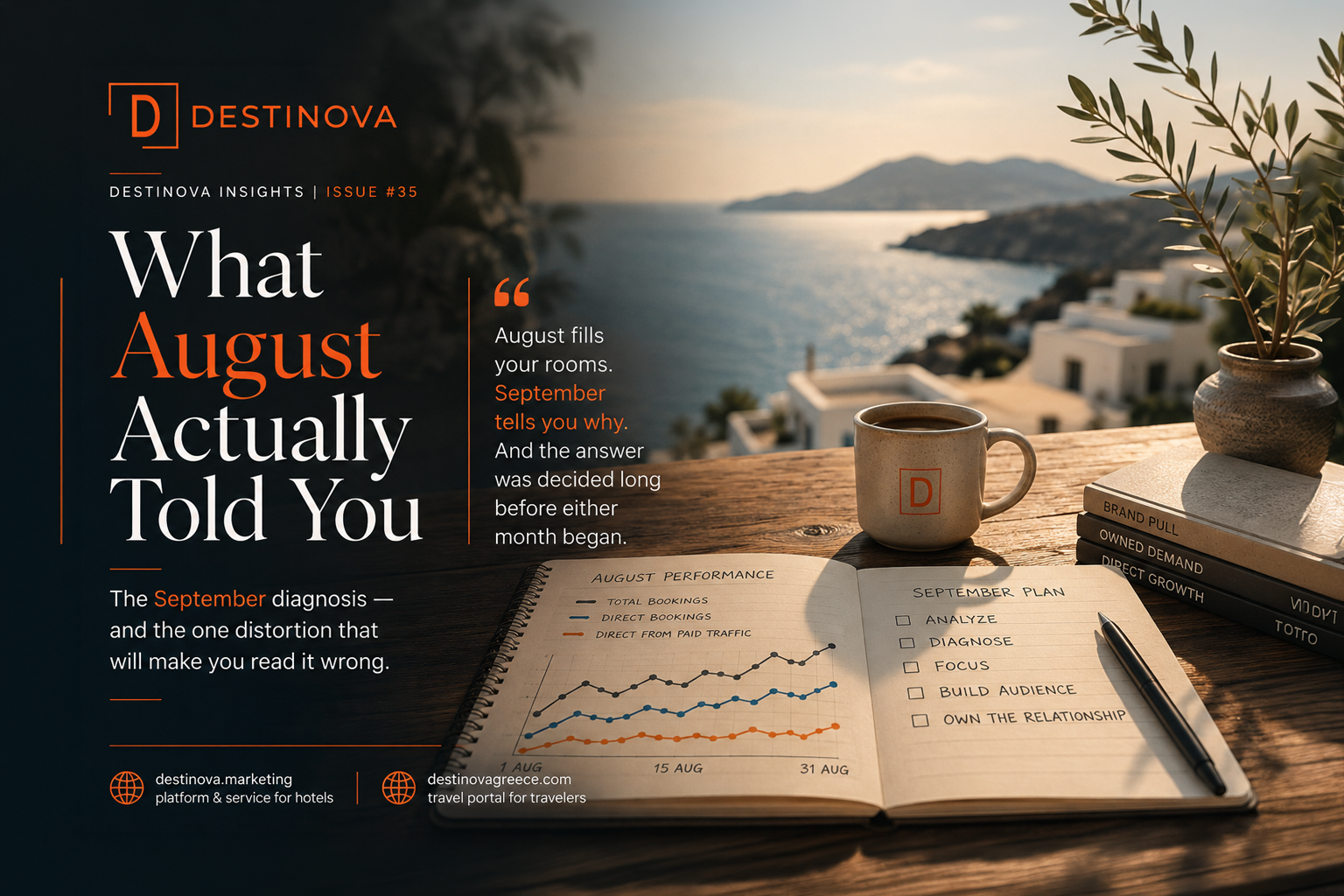
High occupancy in August isn’t proof your marketing works — it’s proof demand is loud enough to hide whether it works. The real test comes in September.
Browse the series by topic — from the OTA equation to ownership, loyalty, content and systems.
Most hoteliers think the booking decision happens at checkout. It doesn’t — it’s made in the first 90 seconds, long before the descriptions.
The off-season isn’t quiet — your communication is. Demand still moves; it moves toward brands that stay present.
If your only argument for direct is 5% off, you’ve already lost. Pricing is what you charge; positioning is why they pay.
Every hotel measures bookings. Almost none measure near-bookings — and that’s where revenue quietly disappears.
A 20% open rate isn’t an email problem. It’s a relevance problem wearing an email problem’s clothes.
Most guests don’t remember where they stayed. Memorability isn’t accidental — it’s built after the stay.
Being everywhere doesn’t mean being chosen. The winning brands aren’t the loudest — they’re the most understood.
Uncertainty doesn’t stop travel — it reallocates it. The winners aren’t the most visible, but the most relevant.
A booking feels like ownership. Often it creates dependency. If you can’t reach the guest again, it was never yours.
Repeat bookings are visible. Loyalty is not. Familiarity brings guests back; preference keeps them.
Performance can look strong. Predictability is what makes it sustainable — and lets you grow with confidence.
Revenue growth isn’t success — it’s activity. Volume is loud; margin is silent, and what’s silent gets ignored.
Direct was never meant to compete with OTAs. Direct is about control — and control changes the business model.
Commission isn’t the real threat — dependency is. Full occupancy hides the fragility; data ownership exposes it.
Insight without action is just observation. The advantage is turning signals into coordinated decisions.
Marketing doesn’t fail. Targeting does. If your marketing speaks to everyone, it’s heard by no one.
Trust isn’t created by one great campaign. It’s built over time — through consistency, not moments.
Visibility without control is fragile. Owning the guest relationship has become the most valuable asset a hotel can build.
As databases grow, campaigns multiply and communication turns noisy. Scaling isn’t about sending more — it’s about aligning everything.
The most profitable booking is the one you don’t have to fight for again. Retention is the quiet growth engine.
Direct bookings don’t grow through isolated campaigns. They grow when every element works together as a system.
Every hotel generates data. Very few turn that data into profit. What you measure shapes what you achieve.
A traveler doesn’t open an email to read an announcement. They open it to confirm a feeling: is this where I want to be next?
A perfectly crafted message at the wrong moment is noise. The right message at the right moment becomes momentum.
The moment a traveler feels a message wasn’t made for an audience — but for them. That’s where personalization becomes hospitality.
Sending the right message to the wrong traveler is like whispering in a crowded room. Precision is the new currency of hospitality marketing.
For every €100 booking, up to €25 goes to intermediaries. It’s time to turn every message into measurable revenue.
A new issue every Tuesday, with practical moves you can apply to your hotel right away.