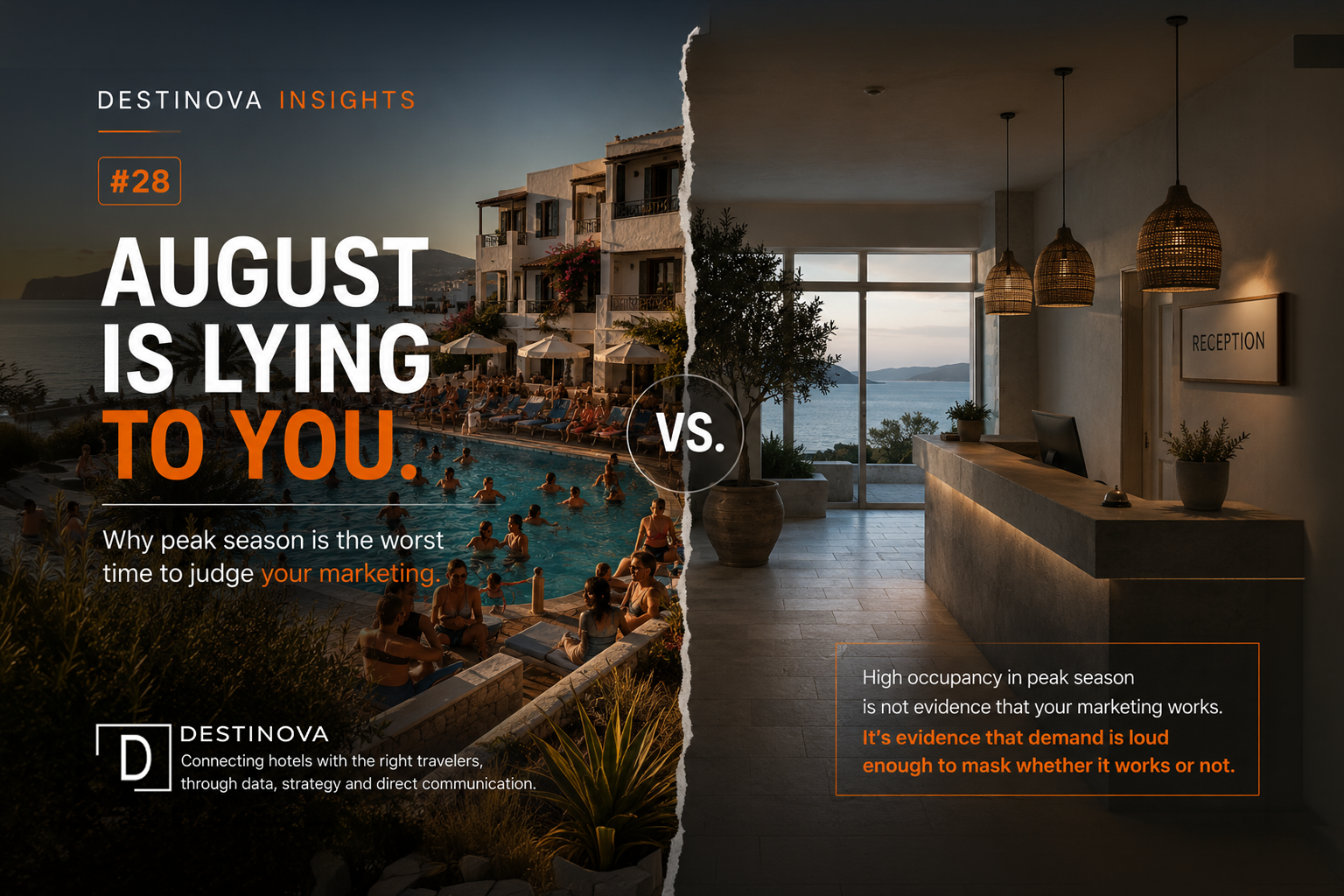
Every August, hoteliers across Greece reach the same conclusion: “Whatever we’re doing, it must be working.”
The rooms are full. The phones are ringing. The revenue is up. And yet — every September, the same hoteliers are surprised when bookings collapse faster than they expected, repeat guests don’t return, and direct bookings remain stubbornly flat. What happened? Nothing happened. The August numbers were never about you.
High occupancy in peak season is not evidence that your marketing works. It’s evidence that demand is loud enough to mask whether it works or not.
What Peak Season Actually Tells You
In August, the Greek hospitality market operates under conditions that distort every signal a hotelier might use to evaluate their business:
- Demand exceeds supply in most destinations, which means even poor-performing properties fill up
- Travelers make compressed decisions — less comparison, less research, lower expectations
- OTAs work hardest when inventory is scarce, capturing share regardless of brand strength
- Pricing power is artificial — you can raise rates without losing bookings, but that’s the market, not your positioning
Under these conditions, almost every hotel looks successful. The luxurious one is full. The mediocre one is full. The overpriced one is full. The under-marketed one is full. This is not success. This is gravity.
Why do hotel bookings drop sharply in September?
Hotel bookings drop in September not primarily because of seasonality, but because peak-season demand masks underlying positioning problems. In August, demand exceeds supply and travelers make compressed decisions, filling almost every property regardless of brand strength. When September’s normal demand returns, only hotels with genuine positioning maintain a meaningful pipeline — the rest experience what feels like a collapse but is actually a return to their real baseline.
The Three Signals That Get Masked
When peak season hides everything, three critical metrics become invisible — exactly when hoteliers most need to see them.
1. Your real direct booking ratio
In August, OTA dependence looks acceptable because total volume is high. A property running 80% OTA / 20% direct in peak season feels fine — the absolute numbers are good. But that ratio is what your business actually runs on for ten months of the year. The summer hides what the rest of the year reveals.
2. Your real guest profile
The August guest is not your typical guest. They’re often a one-time, last-minute, price-driven booker who would never have considered you in October. Building any strategy around what August guests want, value, or respond to is building on an audience that will not return.
3. Your real brand pull
In peak season, every booking feels like it confirms your positioning. But most August bookings happen because the traveler ran out of options — not because they chose you specifically. The hoteliers who confuse these two signals end September wondering why their “loyal August audience” stopped engaging.
You cannot evaluate a brand under conditions where the brand isn’t being tested.
The September Test
The real measurement of your marketing happens in the first two weeks of September. That’s when demand drops sharply but doesn’t disappear, travelers regain time to compare and choose deliberately, OTAs lose their pricing power as inventory opens up, and direct bookings become genuinely competitive again.
If your September pipeline collapses by 70% the moment August ends, you don’t have a seasonality problem. You have a positioning problem that peak season was hiding. The hotels that maintain a meaningful September are not the ones with better summer marketing. They’re the ones whose brand exists independently of demand surge — guests who know who they are, what they’re for, and would have chosen them even without the August pressure.
How can hotels measure the true performance of their marketing?
The most accurate measurement of a hotel’s marketing performance happens in the first two weeks of September, not during peak summer. During peak season, high demand distorts every signal — direct booking ratios, guest profiles, and brand pull all appear stronger than they actually are. September conditions restore normal demand, giving hoteliers a realistic view of whether their marketing genuinely drives bookings or merely rides seasonal gravity.
What This Changes
For hoteliers reading this in the middle of peak season, the implication is uncomfortable: the data you’re celebrating right now is not the data you should be planning around. Every decision based on August metrics — pricing strategy, marketing budgets, channel mix, audience targeting — is being made under distorted conditions. The booking velocity you’re seeing won’t repeat. The OTA performance you’re seeing won’t hold. The “this is working” feeling won’t survive the equinox.
The hoteliers who use August well do something counterintuitive: they collect data, but don’t draw conclusions. They observe patterns, but don’t formalize strategy. They save analysis for September, when the signal is real. Peak season is for running the operation. Off-season is for understanding the business. Confusing the two is one of the most expensive mistakes in hospitality.
If your marketing only works when demand is highest, it isn’t marketing. It’s logistics.
The Quiet Truth
The hotels winning year-round direct bookings are not the ones who optimized for August. They’re the ones who built positioning that didn’t need August — and were rewarded with it anyway. That distinction is the difference between a hotel that lives off the season and a hotel that builds a brand. One of them needs the market to be loud. The other one doesn’t.
What’s the difference between high occupancy and strong brand positioning?
High occupancy during peak season reflects market conditions — high demand, low supply, and reduced traveler choice. Strong brand positioning reflects deliberate selection by travelers who chose you over available alternatives. The distinction becomes visible in shoulder and off-season periods, when only hotels with genuine positioning maintain meaningful direct booking volume.
Worth asking yourself: if next August looked like a normal October, would your marketing still hold up? The answer determines whether you have a strategy — or a window.